










Voronezh, Russian Federation
Voronezh, Russian Federation
UDC 574.34
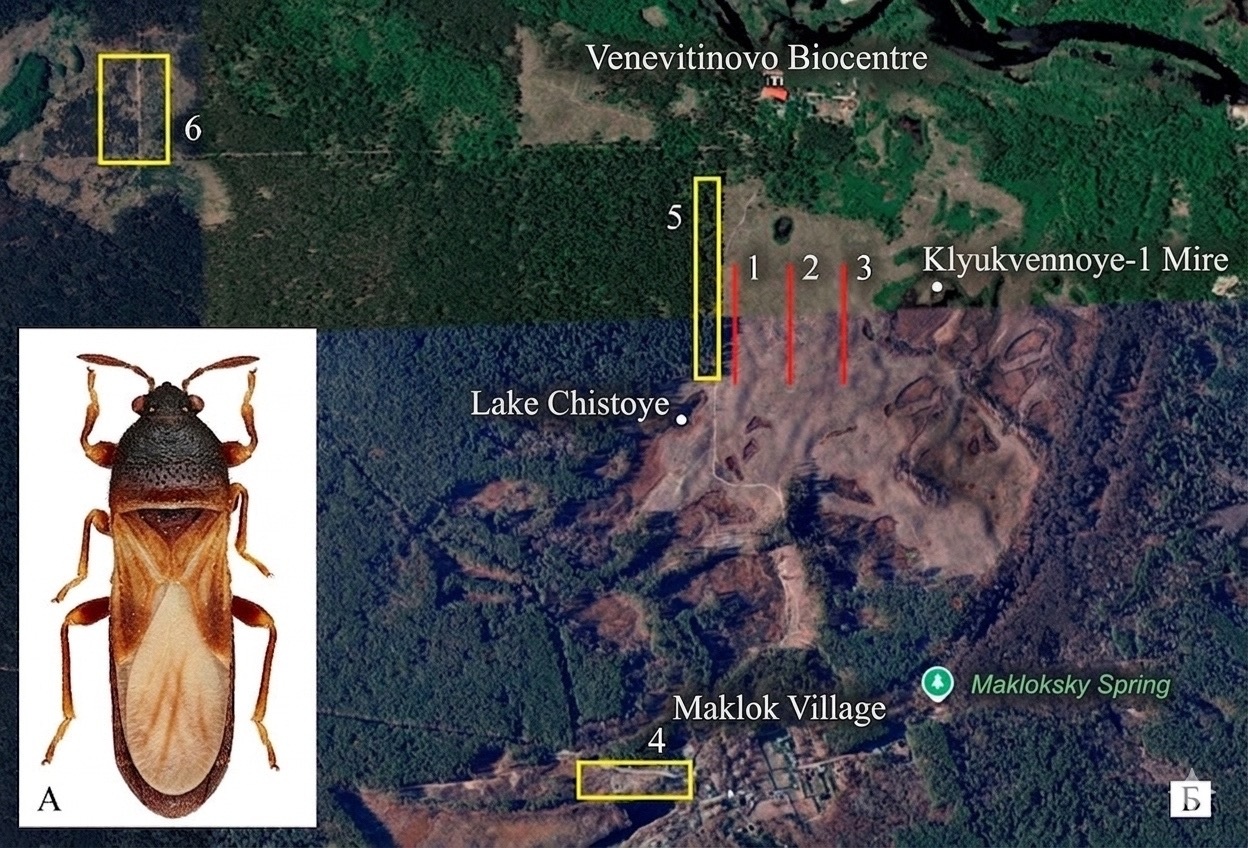
Based on the results of quantitative surveys conducted from 2021 to 2024, the dynamics of abundance and spatial distribution of the xerophilic species – the bug Dimorphopterus spinolae Signoret (1857) (Heteroptera, Lygaeidae) – were studied on a former fire site in the Usmansky Forest (Voronezh Region), formed after the 2010 fire. The formation of a stable population grouping of the species was established. Significant interannual fluctuations in abundance were revealed, with a peak in 2021 followed by a subsequent decline. During the period of maximum abundance, its average values ranged from 10.88 (in the Calamagrostis-Chenopodium association) to 17.88 (in the Festuca-Calamagrostis association) individuals per 100 sweeps with a standard net. In 2023, with the minimum abundance of the species in different plant associations, it decreased by 2.6–11 times. The main limiting factors for the abundance of D. spinolae were high temperature maxima and prolonged drought periods. These factors led to premature drying and hardening of the vegetative parts of the main food plant, Calamagrostis epigeios, which worsened its quality for feeding the nymphs and adults of the bug. The greatest decline in the abundance of D. spinolae was noted in the most xerophilic area occupied by the Festuca-Calamagrostis association (1.63 individuals per 100 sweeps). Under prolonged abiotic stress towards xerophily, more mesophytic conditions ensured better preservation of the food base and a more favorable microclimate, providing for the preservation of the local population grouping of the species. The obtained data indicate the naturalization of the typical meadow-steppe species, the bug D. spinolae, in the conditions of a forming xerophilic biotope in place of the fire site and reflect the general trend of xerophily in the post-fire ecosystem in the Eastern European forest-steppe zone.
Hemiptera, Heteroptera, post-pyrogenic succession, Usmansky Forest, Voronezh Region
1. Aukema, B., Martens, T., Klunder, N., & Prijs, J. (2017). Nieuwe en interessante Nederlandse wantsen VII (Hemiptera: Heteroptera). Nederlandse Faunistische Mededelingen, 48, 45-54.
2. Golub, V.B., & Drapolyuk, I.S. (2005). Otryad Heteroptera. In Kadastr bespozvonochnykh zhivotnykh Voronezhskoy oblasti (pp. 276-316). Voronezh: Voronezhskiy gosudarstvennyy universitet. (in Russ.).
3. Gongalsky, K.B. (2014). Lesnye pozgary i pochyennaya fauna. Moskva: Tovarishchestvo nauchnykh izdaniy KMK. (in Russ.).
4. Gulde, J. (1921). Die Wanzen (Hemiptera – Heteroptera) der Umgebung von Frankfurt am Main und des Mainzer Beckens. Abhandlungen der Senckenbergischen Naturforschenden Gesellschaft, 37(4), 329-503.
5. Gulde, J. (1936). Die Wanzen Mitteleuropas. Hemiptera Heteroptera Mitteleuropas. Die Wanzen Mitteleuropas. Hemiptera Heteroptera Mitteleuropas. Frankfurt a. M. Teil II, 1-104.
6. Jorgensen, A., Alfaro-Sánchez, R., Cumming, S., White, A., Degré-Timmons, G.É., Day, N., Turetsky, M., Johnstone, J.F., Walker, X.J., & Baltzer, J.L. (2023). The Influence of Postfire Recovery and Environmental Conditions on Boreal Vegetation. Ecosphere, 14(7), 1-17. https://doi.org/10.1002/ecs2.4605
7. Milkov, F.N., & Gvozdetskiy, N.A. (1986). Fizicheskaya geografiya SSSR. Obshchiy obzor. Evropeyskaya chast. Kavkaz. Moskva: Vysshaya shkola. (in Russ.).
8. Payette, S., & Fregeau, M. (2019). Long-term succession of closed boreal forests at their range limit in eastern North America shows resilience to fire and climate disturbances. Forest Ecology and Management, 440, 101-112. https://doi.org/10.1016/j.foreco.2019.03.015
9. Péricart, J. (1999). Hémiptères Lygaeidae euro-méditerranéens. Vol 1. Généralités. Systématique: Premiere partie. Faune de France. Paris: Fédération française des Sociétés des Sciences Naturelles. Vol. 84A. 468 p.
10. Péricart, J. (2001). Family Lygaeidae Schilling, 1829 – seed-bugs. In Catalogue of the Heteroptera of the Palaearctic Region (Vol. 4, pp. 35-220). Amsterdam: The Netherlands Entomological Society.
11. Puchkov, V.G. (1969). Ligeïdi. Fauna Ukraïni, 21(3). Kiïv: Naukova dumka. (in Ukr.).
12. Soboleva, V.A., & Golub, V.B. (2022). Postpirogennye izmeneniya v strukture kompleksa poluzhestkokrylykh nasekomykh (Hemiptera, Heteroptera) v Usmanskom boru (Voronezhskaya oblast). In Organizmy, populyatsii i soobshchestva v transformiruyushcheysya srede: Materialy XVII Mezhdunarodnoy nauchnoy ekologicheskoy konferentsii (Belgorod, 22–24 noyabrya 2022 g.) (ss. 181-184). Belgorod: Belgorodskiy gosudarstvennyy natsionalnyy issledovatelskiy universitet. (in Russ.).
13. Svyatodukh, N.Yu., & Golub, V.B. (2015). Ekologicheskie kompleksy poluzhestkokrylykh (Heteroptera) v sostave gerpetobiya Tellermanovskoy dubravy (Voronezhskaya oblast). Izvestiya Sankt-Peterburgskoy lesotekhnicheskoy akademii, (211), 105-118. (in Russ.).
14. Vinokurov, N.N., Kanyukova, E.V., & Golub, V.B. (2010). Katalog poluzhestkokrylykh nasekomykh (Heteroptera) aziatskoy chasti Rossii. Novosibirsk: Nauka. (in Russ.). 1
15. Wachmann, E., Melber, A., & Deckert, J. (2007). Wanzen. Band 3, Pentatomomorpha I. Aradidae, Lygaeidae, Piesmatidae, Berytidae, Pyrrhocoridae, Alydidae, Coreidae, Rhopalidae, Stenocephalidae. Die Tierwelt Deutschlands. Teil 78, 1-272.